
An independent review of the council's £51m i360 loss says visitors were forecast at 822,584 a year against about 270,000. Councillors see it on 24 November.
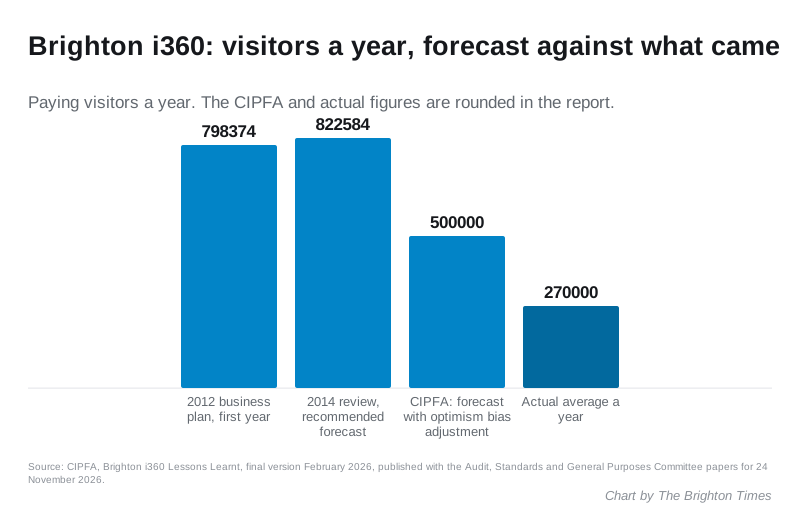
The business plan behind the council’s loan to the Brighton i360 suffered from “optimism bias from the outset”, an independent review has found. It forecast more than 800,000 paying visitors a year. The attraction averaged around 270,000.
The review was carried out by CIPFA, the professional body for public finance. It is published with the papers for the council’s Audit, Standards and General Purposes Committee on Tuesday 24 November. Councillors are asked only to note it.
Overview
- The council lost £51m when Brighton i360 went into administration. That covers the loans it made, loans it took over and interest that had built up unpaid.
- The council borrowed that money itself and is repaying the Public Works Loan Board until 2041.
- CIPFA found the visitor forecasts were roughly three times what the attraction achieved.
- It makes 11 recommendations for future council investments.
- The report is dated February 2026 and reaches councillors on 24 November.
How much the council lost
The council’s covering report sets out the figure. “When Brighton i360 went into administration, the Council lost £51m owed to it in loans made, additional loans novated and rolled up interest that had not at that point been repaid,” it says (council report).
That is an ongoing cost to the council, because the money it borrowed to lend is being repaid to the Public Works Loan Board until 2041.
Cabinet agreed on 23 January 2025 to commission an independent investigation into the original decision to lend public money for the i360. This is that report.
The forecasts against what happened
The 2012 business plan expected 798,374 paying visitors in the first year. A 2014 review by D & J Consulting gave high, medium and low forecasts of 982,922, 822,584 and 599,242, and recommended the medium one. In reality the attraction averaged around 270,000 visitors a year (CIPFA report).
CIPFA called those forecasts “naïve”. It said they assumed 3.6 to 4% of the local and tourist population would visit. Covid and the economic downturn that followed also cut visitor numbers, and the business case had no provision for shocks like those.
Money was forecast the same way. The plan expected £11.7m in revenue and £6.7m in EBITDA (earnings before interest, tax, depreciation and amortisation) in the first year. That was meant to be enough to run the attraction and service the £36m loan from the council. Instead, the report says, the i360 “struggled to break even and eventually defaulted on its loans”. Spending at the Sky Bar and on merchandise also came in below what was expected.
With a standard optimism bias adjustment, CIPFA says, the first-year forecast would have been closer to 500,000 visitors and EBITDA around £5m. That “may have flagged early concerns about loan repayment capacity”.
What the review says went wrong
The report found:
- the plan compared the i360 with the Eiffel Tower, the CN Tower and the Empire State Building, when the Spinnaker Tower in Portsmouth, Blackpool Tower and SEA LIFE Brighton would have been fairer comparisons
- only one firm checked the attendance and financial forecasts independently
- there was no pilot or phased opening to test demand
- the risk register did not model the chance of the operator failing to repay the council
- reputational risk, governance risk and shocks such as a pandemic or cost of living crisis were left out of the risk register
- there was no way of revisiting the forecasts once the attraction opened, so “early warning signs were missed”
- the council lacked commercial skills, and the operating company’s senior team had no finance chief named in the plan
What the review says went right
It is not all criticism. CIPFA calls the concept “fundamentally sound” and says the project was delivered on time and within its construction budget.
The report says the attraction was reported to have supported about 450 jobs and nearly £30m a year for Brighton’s economy. It also notes the project was planned when councils were being encouraged to borrow cheaply and invest commercially.
What it means for you
The £51m is not a one-off. It is money the council is still paying back, through to 2041, out of the same budget that funds local services. The report does not set out the yearly cost of that repayment.
The review does not name any councillor or council officer. Its 11 recommendations are about how future projects are tested: optimism bias adjustments, worst-case scenarios, independent checks on demand, and regular reviews after opening.
The committee meets at 4pm on Tuesday 24 November in the Council Chamber at Hove Town Hall.
Have your say