
The council's draft 10-year supported housing strategy says the city needs more homes with support for working-age adults, older people and young people. Comments close 21 December.
Brighton and Hove needs at least 180 more supported living places for working-age adults by 2032, the council says in a draft strategy now out for comment. It also needs at least 130 more extra care and sheltered places for older people in the same period.
The figures come from the council’s draft Supported Housing Strategy 2027 to 2037. The consultation opened on Monday 9 November and closes on Monday 21 December 2026.
Supported housing is a home that comes with care, support or supervision. It ranges from sheltered flats for older people to hostels for people who have been homeless and refuges for people escaping an abusive partner.
Why the council is doing this now
A new law, the Supported Housing (Regulatory Oversight) Act 2023, makes every council in England publish a supported housing strategy. The government plans to set 31 March 2027 as the deadline for the first ones.
The council has chosen to plan over 10 years rather than the five the law asks for. It says changing the number and type of homes takes longer than five years, because of land, funding and building times. It will review the strategy by 2032, as the Act requires (council announcement, 10 November).
What the city has now
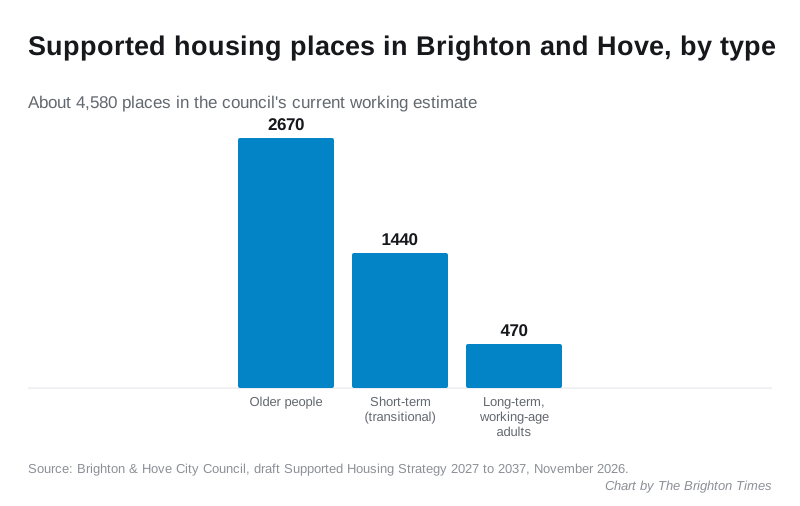
The council’s current working estimate is about 4,580 supported housing places:
- about 2,670 for older people, in sheltered, retirement and extra care housing
- about 1,440 in short-term housing that people move through, such as homelessness, recovery and rehabilitation services
- about 470 long-term places for working-age adults, for example people with a learning disability, autism or long-term mental health needs
Where the gaps are
The draft is based on a needs assessment carried out for the council. It gives these estimates of what the city needs on top of what it has:
| Group | Extra places needed by 2032 | By 2037 |
|---|---|---|
| Working-age adults with long-term support needs | at least 180 | at least 200 |
| Older people whose care the council arranges | at least 130 | at least 150 |
| Young people | about 100 | about 100 |
| Domestic abuse safe accommodation | about 22 | about 28 |
The council calls these interim planning estimates, not fixed targets, and says it will confirm them in the final strategy.
Some of the need is already visible. About 80 people with mental health needs and 40 people with learning disabilities are waiting for supported housing. That includes around 20 people with mental health needs who are in hospital or discharge-to-assess beds.
The draft says the older people figure counts only people whose care the council arranges, so the city’s wider need is larger. The number of older people likely to need care will grow by about a quarter by 2037, it says.
For people moving through homelessness and recovery services, the picture is different. The assessment found about 410 adults with unmet housing-related support needs:
- around 190 people experiencing single homelessness
- around 200 people with substance use-related needs
- around 20 prison leavers
Here the council thinks the total number of places may be broadly enough. The problem is the mix: it says the city needs more high-support places, more flexible housing-led approaches and better ways for people to move on.
People placed outside the city
The draft is frank about one problem. “Too many people with support needs end up living away from the city and their family and friends,” it says. That includes people with complex needs placed outside Brighton and Hove “because nothing suitable exists here”.
It also says many people who are ready to leave supported housing cannot, “because there’s nowhere suitable to move to”. The council promises to find out who is placed out of area and why, and to build local provision where the evidence supports it.
Licensing is coming, but not yet
The same Act brings in national standards and a licensing scheme for “exempt” supported housing. That is housing with support where Housing Benefit is not capped at the usual Local Housing Allowance rate.
The government published draft licensing regulations on 15 October 2026. The council says licensing “is unlikely to be in force until late 2027 at the earliest”. Until then, it says it will act on poor supported housing using the powers it already has.
Councillor Gill Williams, Cabinet Member for Housing, said: “We know we need more high-quality supported housing in the city. The key strand of our draft strategy is making sure homes are available to provide people with the right support at the right time.”
A second survey, on adult social care
The council is running a separate survey on the future of adult social care, as part of the national “Big Conversation on Care”. Its answers will shape the city’s response to the Casey Commission on Adult Social Care, whose final report is due in summer 2027.
That survey is open until 20 December (council announcement, 9 November; survey).
What it means for you
- If you live in supported housing, work in it or care for someone who does, this is the strategy that will shape what is commissioned in the city for the next 10 years.
- You can comment until Monday 21 December through the council’s Your Voice survey. The draft, a short summary, an Easy Read version and a summary of the needs assessment are on the same page.
- Paper copies are available. Write to SHROA, Housing Leadership Support Team, Brighton & Hove City Council Housing Centre, Unit 1, Fairway Trading Estate, Brighton, BN2 4QL.
- After the consultation, the council says it will publish a report of what it heard and what changed as a result.
Have your say