
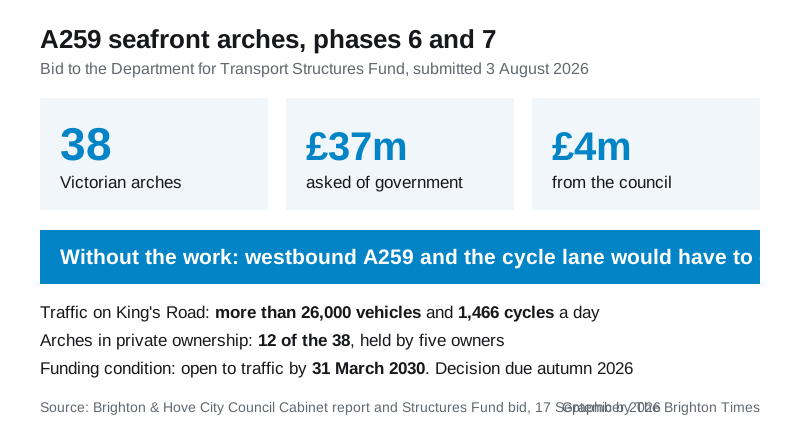
The council's own bid says the westbound A259 and the seafront cycle lane would have to close without repairs. It wants £37m from government and is adding £4m.
Brighton & Hove City Council has told the government that if 38 Victorian arches under King’s Road are not rebuilt, it will have to close the westbound carriageway of the A259 and the seafront cycle lane. That warning is in the council’s own bid to the Department for Transport’s Structures Fund, published this week with a Cabinet report (Cabinet agenda item 50, 17 September 2026).
The bid asks for up to £37 million. Cabinet is being asked to add £4 million of council money to it, making a scheme of roughly £41 million.
The same meeting decides on a rise in taxi fares and the city’s park rules and £100 fines.
The bid went in before Cabinet saw it. The Department for Transport’s deadline was 3 August 2026, and the report says officers submitted it on the basis that the local contribution would come back for approval afterwards (DfT Structures Bid, King Arches Phases 6 & 7).
What the surveys found
Structural surveys carried out in June 2026 confirmed the condition of the arches in phases 6 and 7. The bid lists what inspectors saw:
- cracking and localised spalling
- minor areas of corrosion to steel joists
- water ingress, staining and seepage
- paint flaking and deterioration of finishes
- other water-related defects to elements supporting or immediately below the deck
Large areas of the deck soffits, the underside of the structure carrying the road, were hidden behind paint, cladding and suspended ceilings, so the council says their condition could not be fully verified. Its conclusion is that all the existing filler joist slab decks need replacing.
The arches in this phase were built at the same time as ones already rebuilt, and the bid says they are “approaching the end of their useful life and are in urgent need of replacement to avoid collapse and the closure of the road”.
This has happened before
The council is not arguing from theory. Its bid records that a section of the A259 was closed in 2012 and again in 2014 after the supporting arches failed structurally, and that a localised repair took about 12 months, with knock-on damage to businesses and tourism.
The road is not currently weight-restricted or closed. But there is already a restriction of a different kind. The handrails on the upper promenade are too low for modern standards, and after several incidents and near misses reported by the public the council barriered them off. The bid says the drop behind them is around six metres, and that the barriers have narrowed the space for pedestrians and cyclists along the length of the scheme. Replacing them is part of the work.
Why it matters if the road shuts
King’s Road carries more than 26,000 vehicles a day and 1,466 cycles, as part of National Cycle Route 2. The bid sets out what a failure would mean:
- cyclists diverted an extra 0.55km, onto roads with no dedicated cycle facilities
- traffic pushed through central residential areas that are home to more than 100,000 people, according to the 2021 census
- the strategic diversion routes running through areas with more residents over 65 and more household deprivation
The council puts the benefit to cost ratio at 19.2, with present value benefits of £804.5 million against costs of £41.8 million. That is the council’s own submission to the department, calculated with the DfT’s economic toolkit, and it has not been independently tested.
Who owns the arches
Most of the 38 arches belong to the council. Twelve are privately owned, by five separate owners. The bid says those owners have been in discussions with the council and support the scheme, and that they are “fully aware of the powers the Council has under the Highways Act”.
The works would extend the life of the structure by 120 years and refurbish the commercial space behind the arch fronts on the lower promenade, which is let to seafront businesses. The council’s legal advice flags this as a risk to manage: the work will affect those businesses, and the council would be acting as highway authority, landlord and landowner at the same time. Compensation for tenants and property owners to vacate during the works is written into the cost estimate.
Where the money goes, and when
The £4 million is about 10% of the scheme. Consultants advised the council that a contribution at that level would make the bid significantly more competitive than a smaller one, in what is expected to be a heavily contested national programme. The Structures Fund is worth £1 billion nationally.
Approving the contribution does not commit the council to spend it. The report is explicit that no binding financial commitment is created, and that the council can ask to withdraw before the announcement.
The timetable:
- Bid submitted: 3 August 2026
- Government decision: autumn 2026
- Construction anticipated: 2028/29 to 2029/30
- Open to traffic: by 31 March 2030, a condition of the funding
If the bid succeeds, officers return to Cabinet for approval to proceed to design and construction, with a full business case, a funding strategy and sensitivity analysis on cost overruns.
The Sussex and Brighton Strategic Authority and Transport for the South East have both written letters of support.
What it means for you
Nothing on the seafront changes this month. What is being decided is whether the council backs its own bid with £4 million.
There is no consultation at this stage. The report says the bid “does not constitute a decision to commence construction works”, and that detailed engagement with businesses, residents, stakeholders and ward councillors would follow only if the money is secured. If you run a business in the arches, that engagement is the point at which the terms of vacating during works would be discussed.
The most useful thing to watch for is the autumn announcement. If Brighton misses out, the council says it would be left with “full future liability for maintaining and renewing the arches” on its own, and the June surveys say that work cannot wait indefinitely.
What we could not confirm: the council has not published which stretch of King’s Road phases 6 and 7 cover. Its public page on rebuilding the seafront arches describes phases 1 to 5 only, with phase 4 between the bandstand and the i360 and phase 5 west of Shelter Hall. The bid gives an Ordnance Survey grid reference but no street boundaries, and we will not guess at them. We will update this piece when the council publishes the extent.
For what is currently shut and diverted on the city’s roads, see our Brighton roadworks and travel page.
Sources
- Cabinet agenda, Thursday 17 September 2026, Brighton & Hove City Council
- DfT Structures Bid, King Arches Phases 6 & 7, agenda item 50
- Appendix 1: Structures Fund bid template
- Rebuilding the seafront arches, Brighton & Hove City Council
Have your say