
Dog bans extend to Blakers Park and Preston Park velodrome and four new orders carry £100 fines, but the drone and dog-walker bans are dropped.
Two proposed bans have been dropped after Brighton residents voted them down, and four new ones carrying £100 fines are going ahead. Brighton & Hove City Council’s Cabinet decides on Thursday 17 September on the whole set of Public Spaces Protection Orders governing behaviour in the city’s parks, beaches and streets (Cabinet agenda item 54, 17 September 2026).
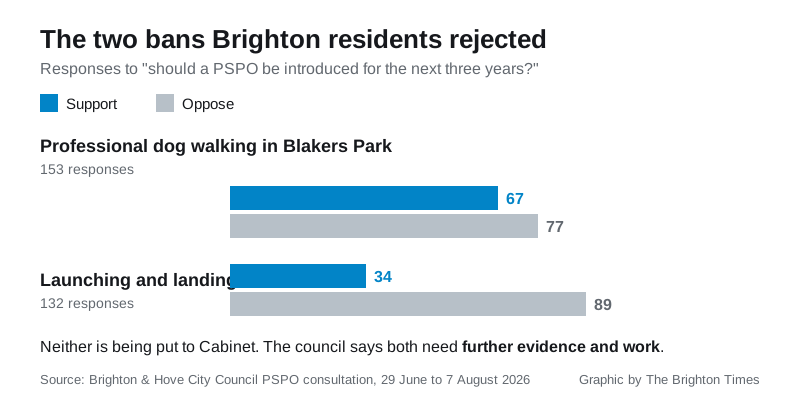
The proposals the council is not putting forward are a ban on launching and landing drones on council land, and a ban on professional dog walking in Blakers Park.
The reason is straightforward. On both, more people opposed than supported, on every single question asked (PSPO report, paragraph 3.7).
The two that were voted down
The professional dog walking proposal drew 153 responses. On introducing a three-year order, 67 agreed and 77 disagreed. On the £100 fine, 66 agreed and 78 disagreed.
The drone proposal drew 132 responses and was rejected far more heavily. Only 34 people backed a three-year order, against 89 opposed. On the fine, 23 agreed it was fair and 94 did not.
Interestingly, the drone consultation showed people were not against the principle. A total of 57 respondents wanted the council to stop people flying drones where Civil Aviation Authority rules were not being followed. They just did not want a PSPO and a fixed penalty as the way to do it.
The report says both need “further evidence, impact, and work”.
The same Cabinet meeting decides on a rise in taxi fares and a £41m bid to rebuild the seafront arches.
The four new orders going ahead
Each would run for three years and carry a £100 fixed penalty notice. All apply across council land citywide, so that people cannot simply move from one park to another.
- Unauthorised overnight recreational camping. Backed by 81 of 96 respondents. The report is explicit that it targets recreational camping and excludes “any targeting/prohibition of people who are homeless/rough sleeping”
- Unauthorised overnight stays in campers or vehicles adapted to be lived in. Backed by 50 of 62 respondents. Regency Square is named as an example location. These are council parks and open spaces, not the on-street rules in our guide to parking in Brighton
- Unauthorised vehicles entering parks and open spaces. This drew just 16 responses, the smallest of any question in the consultation. The reasons given are risk to pedestrians, churn and compaction of grassland, and the effect on legitimate businesses. Hove Park is named as an example
- Unauthorised trading in parks and open spaces. This drew 14 responses. Hove Park and Blakers Park are named as examples
The camping orders come with a stated process. A separate Cabinet report on encampments says officers will visit sites to distinguish recreational camping from homelessness, will explain the restrictions and point people to lawful camping provision, before enforcement is even considered (Management of Tent and Vehicle Encampments).
The council’s lawyer puts it more bluntly in that report. Government guidance “strongly recommends limitations” on enforcement against people in tents, a PSPO “should not be used to make rough sleeping (as opposed to leisure camping) in tents unlawful”, and going further than the current draft “places the Council at risk of legal challenge”.
What changes for dog owners
Four existing dog orders are being renewed for another three years, and three of them are being widened.
Dog exclusion areas would extend to:
- the fenced area of Blakers Park
- Preston Park velodrome and the cricket pitch
Those join the existing exclusions, which cover every council children’s play area enclosed by fencing, named cemeteries on Lewes Road, Bear Road, Old Shoreham Road and Victoria Road, fourteen named squares and gardens from Brunswick Square to Kipling Gardens in Rottingdean, and the beaches from May to September except for the four marked dog-friendly stretches.
Two orders lose their farmland exemption. Dog fouling and dogs on leads currently do not apply to council agricultural land. Both would be extended to cover it. The woodland and Forestry Commission exemption stays.
The council’s answer to objections is in paragraph 3.10 of the report: the exclusions “designate limited areas where dog-free access is prioritised”, and “the vast majority of park space remains available for responsible dog walking”.
Dog exclusion drew by far the biggest response of the whole consultation, with 1,442 people taking part.
Fires join the barbecue ban
The single-use disposable barbecues, lanterns and balloons order is being renewed and widened to prohibit lighting an unauthorised fire.
That was supported by 34 of 41 respondents. The £100 fine for it was the narrowest result among the renewals, with 22 in favour and 14 against.
The six gated alleyways
Six existing gating schemes are also up for renewal: Brunswick Row, Farman Street, Nelson Row, Oxford Court, Pool Passage and St James’s Court.
These went through a separate statutory process. The proposal and the draft order were posted to every address in each affected area, attached to each gate for 28 days, and sent to Sussex Police, the Police and Crime Commissioner, ward councillors and the local MP.
The council’s finding is that incidents inside the gated areas have fallen, but crime in the surrounding streets has not, so removing the gates risks the problems returning. If Cabinet approves, and no legal challenge is made within six weeks, the orders are sealed and published.
What it means for you
The consultation has closed, so there is no further chance to comment before the decision on Thursday.
What to know if the orders are made:
- The penalty for breaching any of them is a £100 fixed penalty notice. That was broadly supported across the consultation, though support was thinner on some individual orders
- A PSPO lasts a maximum of three years under the Anti-social Behaviour, Crime and Policing Act 2014, and has to be consulted on again to be renewed
- If you walk a dog in Blakers Park or at Preston Park velodrome, check the signs before the new exclusions take effect
- If Cabinet refuses, the existing orders expire and the council loses the enforcement powers attached to them. Several have already expired, including the disposable barbecue order, which ran out on 4 August 2025
The council also says a smaller group of respondents argued for a more targeted approach, distinguishing camping from fly-camping and isolated noise from persistent nuisance, and focusing on hotspots and repeat breaches. The report says that feedback “will inform operational implementation and officer decision-making”, which is not the same as writing it into the orders.
Sources
- Cabinet agenda, Thursday 17 September 2026, Brighton & Hove City Council
- Public Space Protection Orders: Permission to Renew, Extend and Adopt New, agenda item 54
- Appendix 1: renewal of current PSPOs, Appendix 2: extensions, Appendix 3: new orders
- Appendix 4: consultation responses
- Management of Tent and Vehicle Encampments, agenda item 52
Have your say