
Brighton and Hove smokers can get free vape kits, patches and one-to-one help. A new county guide shows friends how to start the conversation in 30 seconds.
A new guide on how to talk to someone about giving up smoking has been published by East Sussex County Council, and most of it works just as well on the Brighton side of the boundary. The only part that changes is where you send people. Someone who lives in Brighton and Hove goes to the city council’s Healthy Lifestyles Team, which offers free one-to-one support and free vape starter kits. Someone in Lewes, Peacehaven or Newhaven goes to One You East Sussex. (East Sussex County Council, Start the conversation and help others go smokefree, 28 October 2026)
The county’s public health team wrote the guide, Everyday conversations to build a smokefree East Sussex, with FrameWorks UK, a not-for-profit communication research organisation. It is aimed at residents and at people who meet the public through their work. It argues that a conversation of “just 30 seconds of your day” could be “the spark that leads to months, or even years, of extra life for someone”. (Everyday conversations to build a smokefree East Sussex, PDF)
What the council says
Darrell Gale, Director of Public Health at East Sussex County Council, said: “There can be many different barriers to people stopping smoking but finding the right support doesn’t need to be one.
“By encouraging people to start a conversation about quitting, we hope that information about the support that smokers can access will be shared more widely and encourage more people to take that important first step towards making a healthy change.”
He added: “The benefits of stopping smoking are almost immediate and it is one of the best things you can do to improve your health and reduce your chances of developing long-term conditions and dying prematurely.”
Four steps: T.A.L.K.
The guide sets out four steps:
- Tune in: open in a way that builds a connection, thinking about the timing and who else is around.
- Ask: whether the person smokes, politely and without judgement. One suggested line is simply “Do you smoke?”
- Listen: let them lead, and “make it clear that smoking is not their fault and that we all need support sometimes”.
- Know-how: tell them what help is available locally and where to find it.
“You don’t need to be an expert, or to sign up,” it says. If you have just met someone, it suggests explaining that you are talking to everyone who comes in that day. That approach “can be a good way to open the conversation and make people feel less defensive”. If someone does not want to talk, “that’s ok. Don’t force it. Even if someone isn’t interested today, knowing that support is available may help them in the future.”
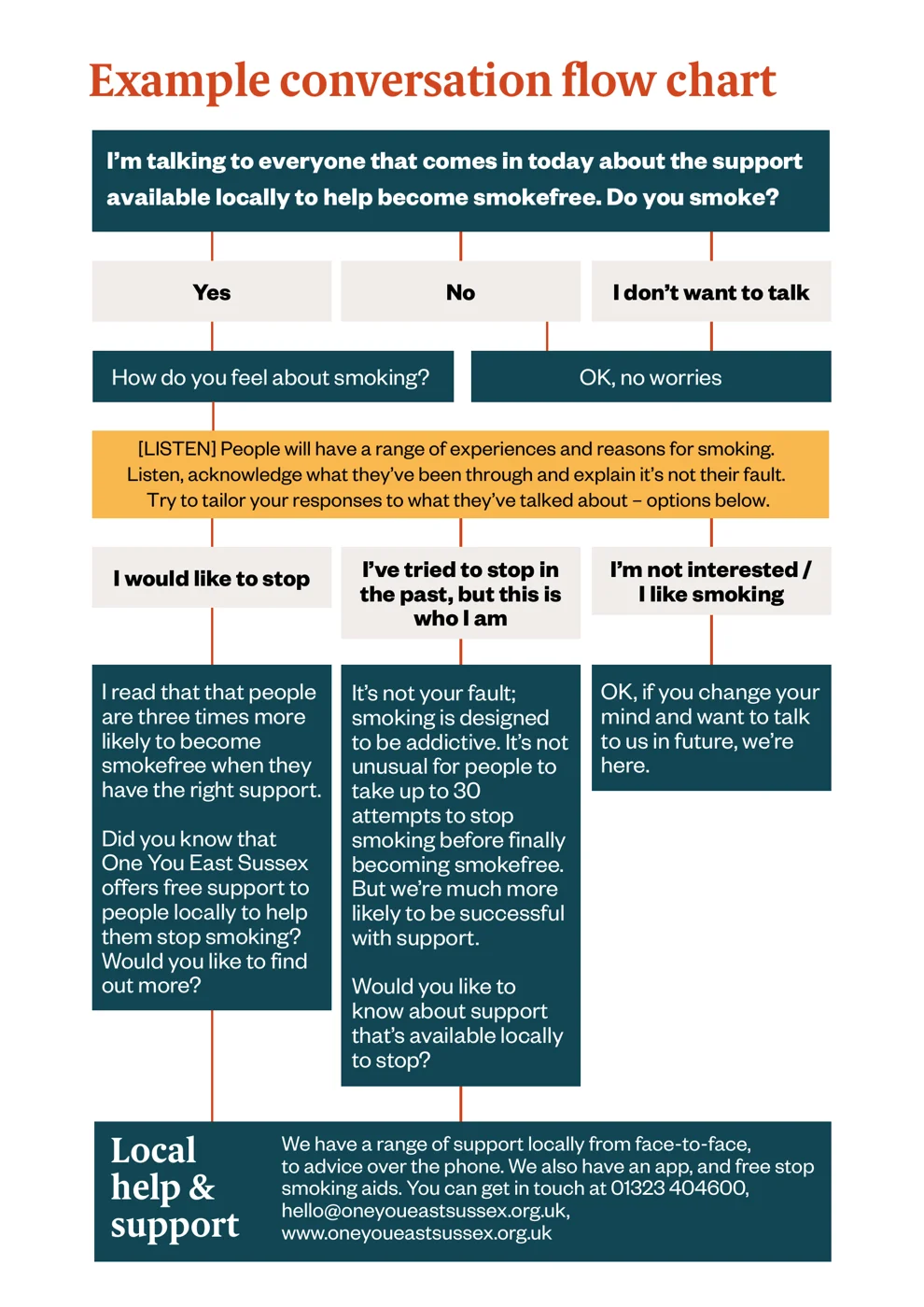
The flow chart ends with One You East Sussex’s details. For a smoker who lives in Brighton and Hove, use the city’s service in that last step instead (details below).
The figures in the guide
The guide makes its case with these numbers:
- People who get the right support are three times more likely to stop successfully.
- It often takes up to 30 attempts to stop before someone finally becomes smokefree.
- Two in three people who try one cigarette end up smoking daily, and three quarters of smokers would never have started if they could choose again.
- Smoking 10 cigarettes a day can cost over £50 a week, over £2,600 a year.
- Within 8 hours of stopping, oxygen levels return to normal. Taste and smell improve after 2 days, and breathing gets easier after 3 days. After 3 months lung function can rise by as much as 10%, and after a year the extra risk of a heart attack is halved.
It also says vapes are “up to 95% less harmful than smoking a regular cigarette”. People who have face-to-face support and use an e-cigarette are more likely to succeed than those who use no stop smoking aid, it adds.
What it means for you
If you live in Brighton and Hove, the free service is the city council’s Healthy Lifestyles Team, along with pharmacies that take part. Its NHS listing was updated on 16 October 2026 and says it offers: (NHS, Healthy Lifestyles Team stop smoking service)
- free one-to-one support in person, over the phone or by video call
- nicotine replacement therapy and stop smoking medicines
- free vape starter kits through the Swap to Stop scheme
- a walk-in service at pharmacies around the city, with no waiting list
- home visits if a long-term condition or illness makes it hard to leave the house
- a specialist adviser for children and young people over 12, and free interpreting, including BSL
You can refer yourself. Call 01273 294589 (Monday to Friday, 9am to 5pm) or use the council’s help to stop smoking pages.
If the person you are talking to lives in East Sussex, for example in Lewes, Seaford or Peacehaven, One You East Sussex runs free support with the provider gloji smoke free. It offers one-to-one appointments with a mentor at a clinic, phone support including evenings and weekends, and a 12-week online programme. It also gives out free quit aids, from e-cigarettes and patches to gum, lozenges and sprays. Places are limited, and being an East Sussex resident is one of the eligibility tests, according to its page, checked on 28 October 2026. Call 01323 404600 or start on the One You East Sussex stop smoking page.
The full guide is seven pages long. It includes the suggested opening lines and the flow chart above.
Have your say