
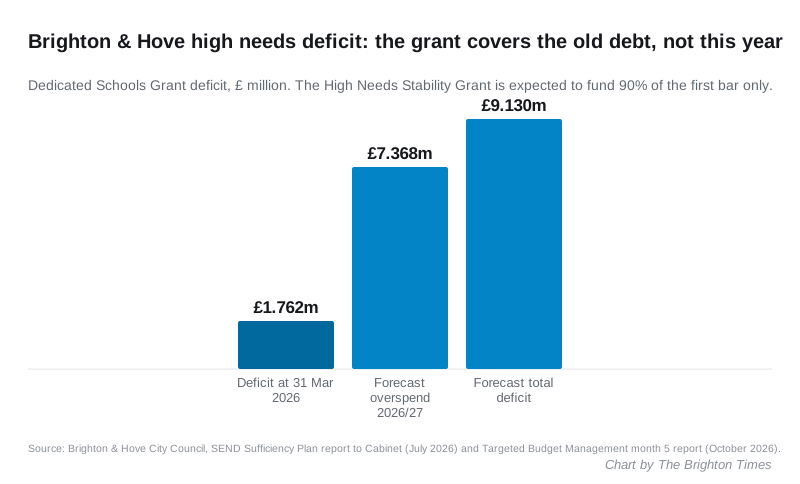
Government approval of Brighton & Hove's SEND plan unlocks a grant for 90% of its £1.762m high needs deficit. This year's £7.4m overspend is not covered.
The government has approved Brighton & Hove’s three-year plan for children with special educational needs and disabilities (SEND). The council announced the decision on Tuesday 13 October. The Department for Education and the Department of Health and Social Care signed it off.
The approval matters for money as well as services. The council’s own reports say a new government grant to pay off most of its SEND debt can only be paid once this plan is approved.
What the approval unlocks
In February the government announced a High Needs Stability Grant for 2026/27. A council report to Cabinet in July set out what it means for the city:
- The grant is expected to fund 90% of the council’s cumulative high needs deficit as it stood on 31 March 2026.
- That deficit was £1.762 million.
- The grant “will only be paid once a local authority has developed and submitted to the Department for Education for a Local SEND reform plan which is then approved as meeting the required criteria”.
- It is “subject to compliance with certain conditions”.
On those figures, 90% of the deficit is about £1.59 million. That is our calculation; the council has not published the amount it expects to receive.
The bigger number is this year’s
The grant covers the debt to March 2026. It does not cover what is happening now.
The council’s latest budget report, published for Cabinet on 15 October, forecasts the Dedicated Schools Grant overspending by £7.368 million this year. The total deficit is forecast at £9.130 million. It says the overspend is “driven by increased demand in the High Needs Block”.
The July report expected the same trend: an in-year deficit of about £7 million in 2026/27 and about £11 million in 2027/28. It also says the government has not yet said how it will handle deficits that build up after March 2026.
The October report adds that the Department for Education is closely checking councils’ past spending “in preparation for the partial write off of overspends”. The council calls that a low risk, because its past spending has been compliant and its overspends have been “relatively low compared to other councils”.
What the plan promises
The council says the plan has three main priorities:
- bringing education, health and care together as one system for children and young people aged 0 to 25
- identifying needs earlier so children get support sooner
- working with families, with clearer information and an improved Local Offer
The first year is for setting up the new services, staff and partnerships. Later years are for putting the changes in place and refining them. The city’s SEND and Alternative Provision Partnership Board will monitor it. That board includes PaCC, the city’s parent and carer forum.
Councillor Emma Daniel, Cabinet Member for Children, Families and Youth Services, said: “We know that too many families have experienced frustration waiting for support or navigating a system that can feel complex and difficult.”
She added that the government’s approval was “a strong endorsement of the local partnership’s work”.
The new places already agreed
Alongside the reform plan, Cabinet agreed on 16 July a programme of new specialist places for 2026 to 2029. The council’s report lists:
| Provision | Places | Planned opening |
|---|---|---|
| Primary Inclusion Intervention Spaces | 80 (10 more spaces) | 2026/27 |
| Stanford Primary School autism base | 12 to 16 | 2027/28 |
| Secondary autism base | 20 | September 2027 |
| Secondary autism and SEMH base | 20 | September 2028 |
| Three primary autism and SEMH bases | 36 to 48 | September 2028 |
Its costing table also includes two phases of a specialist base at Moulsecoomb Primary (The Roost), with eight places each. The full programme is estimated to cost £3.483 million a year once every base is open, paid from the same high needs budget. Each base still needs its own public consultation and decision.
How many children this affects
The July report gives the scale, as of January 2026:
- 1,907 of the city’s 29,847 pupils had an Education, Health and Care Plan (EHCP)
- the council maintained 3,193 EHCPs for residents aged 0 to 25
- 6.4% of pupils had an EHCP, against 6.0% nationally
- 19.7% were receiving SEND support, against 14.8% nationally
- children and young people with autism as their primary need rose from just under 300 in 2016 to over 2,400
The cost of placing children in schools outside the city rose from £5.17 million in 2022/23 to £5.82 million in 2025/26.
What it means for you
- If your child has SEND: nothing changes overnight. Year one is about setting up. Ask your child’s school or the council’s Local Offer about the support available now.
- If you want a say: each new specialist base goes to public consultation before it opens. PaCC sits on the board that will monitor the plan.
- If you pay council tax: SEND overspends sit in a separate schools budget, not the council’s main budget. Home to school transport for children with EHCPs is in the main budget, and the council names it as one cause of its £23.8 million overspend.
Sources
- Brighton & Hove City Council: Government approves Brighton & Hove’s Local SEND Reform Plan, 13 October 2026
- Cabinet report: SEND Sufficiency Plan 2026-2029, July 2026
- Cabinet decision, 16 July 2026: SEND Sufficiency Plan
- Cabinet report: Targeted Budget Management month 5, October 2026
- Brighton & Hove City Council: New plan to strengthen SEND support, 23 June 2026
Have your say