
8,665 people in Brighton & Hove claimed unemployment-related benefits in September, a second monthly rise. The count is up 5.3% in a year, faster than the South East.
8,665 people in Brighton & Hove were claiming unemployment-related benefits in September, 175 more than in August. It is the second monthly rise in a row. The figures are from the Office for National Statistics claimant count, published on Tuesday 20 October (ONS via Nomis).
That is 4.3 per cent of the city’s residents aged 16 to 64. The South East rate is 3.1 per cent and the UK rate 3.9 per cent.
The count is 440 higher than in September last year, when it stood at 8,225. That is a rise of 5.3 per cent over the year.
Rising faster than the region
Claimant numbers went up across the country in September, so the monthly rise is not a Brighton story on its own. The city’s count grew by 2.1 per cent on August. The UK’s grew by about the same, from 1,667,095 to 1,702,905, and the South East’s by 2.4 per cent, from 182,020 to 186,430.
Over the year the gap is wider:
| Area | September 2025 | September 2026 | Change |
|---|---|---|---|
| Brighton & Hove | 8,225 | 8,665 | up 5.3% |
| South East | 179,185 | 186,430 | up 4.0% |
| United Kingdom | 1,657,110 | 1,702,905 | up 2.8% |
August has been revised down
When the August figures came out in September, the ONS put the city’s count at 8,650. That figure has now been revised to 8,490, so August’s rise over July was 40, not the 200 first published. The claimant count’s latest month is provisional and is routinely revised the following month.
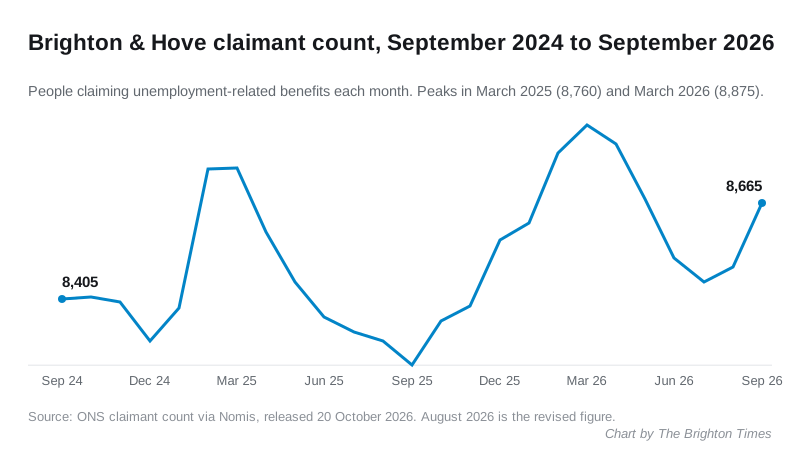
The revision changes the shape a little. Instead of one jump in August, the count has now risen for two months running, and the bigger step came in September.
The winter pattern
The chart shows the same seasonal shape in both of the last two years. The count eased through the spring and summer, bottomed out in late summer or early autumn, then climbed through the winter to a March peak:
- March 2025: 8,760
- September 2025: 8,225, the low point of that year
- March 2026: 8,875, the highest month on the chart
- July 2026: 8,450
- September 2026: 8,665
This year’s turn came earlier, and from a higher base. If the city follows last winter’s path, the count would pass 9,000 by the spring. That is a projection from the pattern, not a forecast from the ONS.
Who is claiming
Of the 8,665 claimants in September:
- 4,865 are aged 25 to 49, the largest group
- 2,195 are aged 50 or over
- 1,610 are aged 16 to 24, of whom 1,600 are 18 to 24
- 5,060 are men and 3,610 are women
The ONS rounds every figure to the nearest five, so the groups do not add exactly to the total.
Where the claimants are
The five wards with the most claimants in September:
| Ward | August 2026 | September 2026 |
|---|---|---|
| Moulsecoomb & Bevendean | 610 | 640 |
| West Hill & North Laine | 570 | 585 |
| Kemptown | 560 | 555 |
| Whitehawk & Marina | 535 | 550 |
| Hanover & Elm Grove | 540 | 545 |
Moulsecoomb & Bevendean had the biggest monthly rise of any ward, up 30. Four wards rose by 20 each: Hollingdean & Fiveways, Patcham & Hollingbury, North Portslade and Woodingdean.
The lowest counts are in Rottingdean & West Saltdean (150), Wish (205) and Westdene & Hove Park (230). The ward figures come from the same ONS release (ward data via Nomis).
What the count is, and is not
The claimant count is not the unemployment rate. The ONS describes it as “the number of people claiming benefits principally for the reason of being unemployed”, and says it “does not attempt to measure unemployment” in the international sense (ONS claimant count methodology). Under Universal Credit it also includes some people in work on low earnings who are required to look for more.
What it means for you
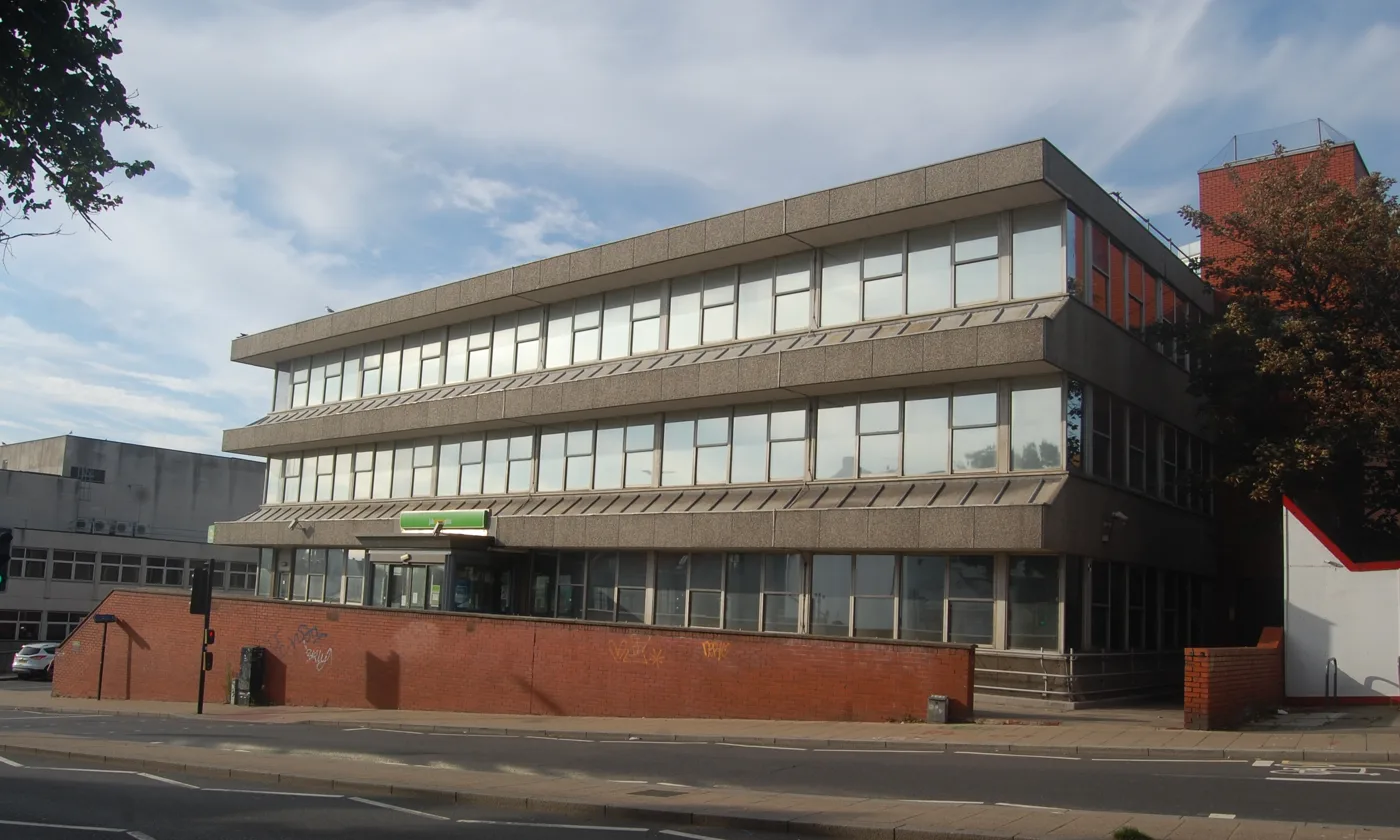
If you are out of work or looking for more hours, the first stop is the Jobcentre at Windsor House on Edward Street, or your nearest one. The National Careers Service gives free careers advice by phone and webchat, and runs sessions at Jubilee Library every Wednesday.
Two free job clubs run in the east of the city each week: at Moulsecoomb Library on Mondays and at The Bevy in Bevendean on Fridays. Times and numbers are in our guide to free digital and job-search help across the city.
Under 25? Ask your work coach about the extra support for young claimants on Universal Credit (DWP guidance).
The figures for October are due from the ONS in November. Our earlier months: August and July. For the city’s other running numbers, see house prices.
Have your say