
Brighton & Hove fixed an estimated 8,328 potholes last year and has won £1.4m more from the DfT. One in seven A roads is still rated red for repair.
Brighton & Hove City Council has been awarded just over £1.4 million by the Department for Transport for road and pavement repairs. The council announced the award on 23 October. It said the money is a reward for work already under way and for publishing its first Local Highways Maintenance Transparency Report (Brighton & Hove City Council, 23 October 2026).
The money is not extra roadworks on top of this year’s plan. The council says the award is “already built into our maintenance plan for this year”.
The report itself is the more useful document for residents. It sets out how many potholes were fixed, how much of the network is in poor condition, and what the council spends (Local Highways Maintenance Transparency Report 2026).
The headline figures
- 8,328 potholes repaired in 2025/26, by the council’s own estimate.
- Around 200 reports a day come in during peak periods, particularly in winter.
- 14% of A roads were in the red category in 2025, meaning they should be considered for maintenance. Another 33% were amber.
- 12% of B and C roads were red in 2025, and 31% were amber.
- 8% of unclassified roads, the residential streets, were red in 2025.
- The council maintains 620km of roads, 1,159km of pavements and 49km of cycle lanes.
The council warns against reading too much into the year-on-year change. The share of A roads in red rose from 6% in 2023 to 18% in 2024. The report says this “reflects the change in methodology rather than a significant deterioration in network condition”, after the council switched to inspections by its own engineers. The Department for Transport is bringing in a new five-category standard from 2026/27, so the figures may shift again.
| Road type | Red, 2023 | Red, 2024 | Red, 2025 |
|---|---|---|---|
| A roads | 6% | 18% | 14% |
| B and C roads | 4% | 15% | 12% |
| Unclassified roads | 11% | 8% | 8% |
Source: Local Highways Maintenance Transparency Report 2026, Brighton & Hove City Council.
Spending is set to rise by three quarters in two years
Total highways maintenance spending was £15.2 million in 2024/25. It rose to £21.9 million in 2025/26 and is projected at £26.8 million for 2026/27. Government money accounts for £15.5 million of this year’s projection; the council and third parties provide the other £11.3 million.
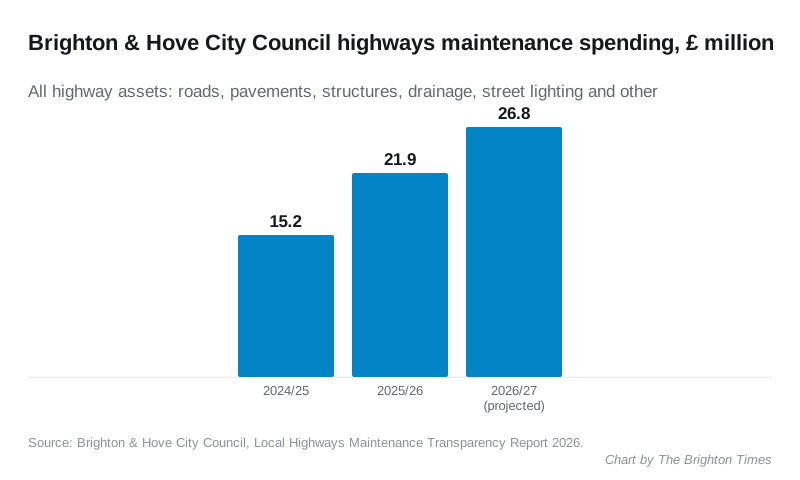
Not all of that goes on road surfaces. This year’s projection includes £8.1 million for carriageways, £2.2 million for pavements, £6.3 million for structures such as bridges, and £3.9 million for street lighting.
Why the city’s roads wear out
The report gives reasons specific to Brighton & Hove:
- around 150km of concrete roads, many near the end of their design life
- the UK’s largest population of elm trees, whose roots damage pavements, kerbs and roads
- the highest bus use outside London, which puts heavy vehicles on residential roads
- salt-laden sea air, which shortens the life of road furniture and surfaces
What is planned this year
The council’s planned work for 2026/27 includes:
- 4km of road reconstruction and strengthening
- 7km of resurfacing
- 11km of micro asphalt, a preventative surface treatment
- 5km of large-scale patching and jointing across 19 sites
- removing 20 tree stumps where roots have damaged the pavement
- restoring 15 to 20 historic lamp columns along Brighton seafront
The council’s release says it intends to double preventative maintenance funding by 2027/28. Councillor Trevor Muten, Cabinet member for Transport and City Infrastructure, said: “Residents are seeing a visible improvement in the condition of our roads, with treatment, resurfacing and repair programmes taking place across the city.”
What it means for you
- Report a pothole through the council’s online map tool, which takes a location and photos and sends the report to the right team. The council does not reply to every report individually.
- A road defect is inspected once it is 40mm deep, and a pavement defect at 20mm. Inspectors then judge the risk. Repairs are made within 2 hours, 24 hours, 7 days or 28 days.
- A temporary repair on a busy road should be followed by a permanent one within 28 days, the report says.
- If the same road keeps breaking up, the council says that usually means the surface has reached the end of its life and needs resurfacing. The road maintenance programme for 2026 to 2027 lists the streets due for work.
- For closures happening now, see our Brighton roadworks and travel page.
Have your say